Showing posts with label Sal Velluto. Show all posts

Sunday, September 26, 2010

Sweden Celebrates 60 years of Phantom!


Yes, yes, we all know that The Phantom turned 60 back in 1996. But his publishing history in Sweden- a great bastion of Phantom Fandom- has just reached it's 60th anniversary and so the The Scandinavian Chapter of the Lee Falk Memorial Bengali Explorers Club has produced a commemorative book "From Purple Ghost to Blue-Yellow Hero".

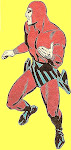
Highlights of this book (which I haven't seen, nor did I receive an advance copy for review purposes-what's up with THAT ?) include a beautiful cover (pictured above) by Phantom fan fave and all-around nice guy Sal Velluto as well as a fascinating tale of his childhood connection to The Phantom, and commentary by such diverse contributors as Phantom great Romano "Roy" Felmang:


Swedish Prime Minister Frederik Reinfeldt:

And journalist,film-critic, movie producer, actor and comics nerd-Pidde Andersson.


I was assured by Andreas Eriksson (Who graciously provided me with the above sneak-peek excepts of the book) that though this book is primarily in Swedish, it contains at least 10% English-language content (which he also stated was 10% more than any previously-published Swedish book about The Phantom)

A detailed list of contents (aimed at curious international collectors) can be found here:
http://www.schapter.org/wiki/Fr%C3%A5n_lila_v%C3%A5lnad_till_bl%C3%A5gul_hj%C3%A4lte

International collectors who are interested in this book can send an inquiry to:
boken@schapter.org

To tie in with the release of this exciting new tome, I briefly interviewed two of the book's contributors, cover artist Sal Velluto and Pidde Andersson who contributed an essay. An essay which I previously published here.

As an added bonus, I'm also including a previously unpublished interview with Felmang.


First up, Sal Velluto:

GWB: So, out of all the living artists to portray The Phantom, you were the one chosen to do the art for the cover of this book. You must have been very excited.

Sal: I resisted the idea of being the cover artist. I believed, and still believe, there are other artists who are more qualified than me to represent 60 years of Fantomen in Sweden. The fans know who I'm talking about.

GWB: How did this come about?

Sal: The folks from The Scandinavian Chapter asked me to contribute an interview and some artwork. They ended up liking the artwork enough to choose it for the cover.

GWB: Were there any special requests from the publishers or were you pretty much free to do your own thing?

Sal: Since my contribution was offered on a pro-bono basis, I was given the freedom to draw whatever I wanted. I like freedom....

GWB: Apart from the cover, can we expect to see any further Sal Velluto art in this book?

Sal: There will be an exclusive interview. Among other things I explain the mysterious circumstances that led me to The Phantom...

GWB: Were you asked to and/or did you contribute, any commentary to the book itself.

Sal: No. I think they ended up with too much material anyway.

GWB: Any plans to do the 100th Anniversary cover?

Sal: If I'm still around, on February 17, 2036 (that's when The Phantom will celebrate his 100th birthday) I'll lobby for a cover collage of the best covers from the past 100 years.


Next up, pop culture geek and friend of this blog, Pidde Andersson:

GWB: Who approached you about contributing to this book and how did you become involved with this project?

Pidde: One of the guys behind the book, Arne Olin, runs a comic book store here in Malmö. I read in a newspaper that Prime Minister Fredrik Reinfeldt had written a piece for an upcoming book about the Phantom, and I mentioned this to Arne. He simply asked me if I'd like to contribute as well.

GWB: Were there any special requests from the publishers or were you pretty much free to do your own thing?

Pidde: I had already written a rather nostalgic article about the cover art of Fantomen in the 1970s on my blog, which in turn was inspired by a thing I wrote for Sal Velluto's blog, and this article was perfect for the book. I reworked it a little before sending it to them.

GWB: What was your connection to The Phantom, growing up?


Pidde: The Phantom, and even more so the Swedish comic book than the character, meant a lot to me. The Phantom stories themselves were most of the time thrilling, I was fascinated by the character's history and world, and many of the adventures - especially the ones produced by Semic - had this heavy, mysterious atmosphere. Dark, lots of shadows - things that disappeared when they started publishing in color. But the thing with the Swedish book, was that they kind of respected the readers. The book offered lots of info about the people making the comics, about the inspirations for the adventures and to on. And they have always crammed the book with wonderful back up comics - they still do. Blueberry, The Spirit, Bernhard Prince, Johnny Hazard, the list goes on and on and on... Fantomen made me interested in comics as a medium and art form, as did Knasen; the Beetle Bailey book, which always featured interviews with- and articles about the cartoonists.

GWB: You've said before that the Swedish Comics scene is on shaky ground, yet The Phantom has stayed in continuous publication for six decades. What do you think is the key to The Phantom's enduring success in Sweden?

Pidde: There are a couple of titles that "have always been around"; they are considered classic titles, so I guess Egmont do their best to keep them alive. I'm not sure who reads these titles, maybe it's the ones who "have always bought them". Meaning, adult, rather old people. I don't know who reads Fantomen today - probably very young kids and their 40+ parents, while teens and 20-somethings don't read comics at all, or stick to alternative stuff. Egmont publishes several thick, hardcover collections with popular comics; the complete Beetle Bailey and so on, and these expensive books are clearly aimed at middle-aged people who read the comics while growing up.

GWB: The Phantom is really quite different in Scandinavia than he is in the U.S.. Would you say that Sweden has a sort of proprietary feeling about the character?

Pidde: Yeah, I think we do. Maybe he's like the Statue of Liberty; nobody cares about the French, small one in Paris, when the Americans have a much bigger and cooler one in New York. And of course, everybody knows who The Phantom is over here, everybody can refer to the character, he's part of the Swedish heritage. Okay, I'm not sure about young kids, of course. Kids today don't think of Batman and Spider-Man as comic book characters, but movie heroes.

GWB: I know that sometimes Scandinavian comics fans don't care for American Phantom comics, even the ones published during Lee Falk's lifetime. Why do you think that is?

Pidde: Well, very few of them have been published over here, almost none. I, as a fan, have of course bought some of the different American incarnations, as have other fans, and they just didn't feel right. I always get the impression the people behind them don't really know the character and his world. Sometimes the art was a bit odd, not different in a cool way, like when a fan fave takes over a Marvel or DC title. Americans also seem to think they need to change the character whenever the title is revived; the old, beloved version won't do. However, since Fantomen is published every other week, 26 issues a year, lots and lots and lots of awful episodes have been produced by Semic/Egmont.

GWB: Do you expect The Phantom to see a 100th anniversary?

Pidde: Short answer: No. Will people read any comic books, printed on paper, at all in 40 years?

GWB: Thanks for your time on this.

Pidde: My pleasure.

And last, but by no means least, My much awaited (by me, anyway) interview with Felmang:


GWB:When and how did you first become interested in art?

Felmang: Since I was a child (5 or 6 years) I spent the great part of my time drawing, in the rest, as many other children I was playing with my two friends (girls of course) Marisa and Floriana.

GWB: Were you a fan of The Phantom before you became a Phantom artist?
Felmang: 2- Mainly not. Since 7 years old I was a fervent reader of the comic art, something of Walt Disney, and especially Italian comics (called strips) with kids as main characters as example Tony Boy, Il Piccolo Sceriffo, Sciuscià (coming from the world Shoe shine), Nat of Santa Cruz, Forza John! and also comic book like Pecos Bill and Pantera Bionda (a sort of Sheena made in Italy). At ten years old I discovered the weekly magazine Intrepido and continued to collect it until the moment I start to cooperate as artist with the same magazine(1970: 750000/ 850000 copies a week,a real record!).I became a Phantom fan at 22 years in the F.lli Spada era, reading the very first adventures drawn by Raymond Moore and the new by Sy Barry.

GWB: Do you prefer The Phantom in Red, Blue or Purple?

Felmang: I'm Italian and of course always I saw the Phantom in red, probably is easy to discover him if hidden in the Jungle, but red is a good color for this character, red put him always in evidence respect the other characters of the strip.

GWB: One morning at the end of 1963 I noticed issue 51 of Il Vascello Mandrake at the newsstand. It was the Un mondo scomparso made by the Italian artist Domenico Mirabella. I bought it and found that Fratelli Spada Publications were produced in Rome.

Felmang: I considered the possibility of pursuing seriously a cartoonist's career. After telephoning the next day after, with my bronze face (as I had at the time) I went to via Enea 77, offices of the Fratelli Spada press, and presented myself as an illustrator of comics, with zero experience.

Daniela, a beautiful girl (niece of mr.Giuseppe Spada) working there in the redaction, gave me a issue of L'Uomo Mascherato from the American Adventures Series. The issue was 60 Le mani sull'isola (Sy Barry's The Island of the Dogs) - saying:

This is a recent story of the Phantom from the United States; the production is syndicated, but it's not enough to cover our weekly requirement. For this reason we need illustrators who imitate Sy Barry, the leading artist of the American comic-strips. Make us a couple of trial panels in this style!

During the following days I tried several times to draw The Phantom of Sy Barry, but the results were very poor. I could not confront such a demanding character tout de suite and succeed in imitating an artist, whom I considered the best at that time. So I had to practice and wait for a later opportunity.

In 1966, after my military service, the editor of F.lli Spada commissioned me I my first 8 pages Phantom story :Kaniska. He accepted the finished story which was also lettered but never published. I made my debut as a Phantom artist soon after, drawing a full length story called I Ladri della tomba del Gran Re . Some more Phantom stories in 1997 and various covers for Fratelli Spada and Editions des Remparts for Mandrake, The Phantom, Rip Kirby and Secret Agent.

GWB: Who (besides yourself) is your favorite Phantom artist?

Felmang: My favourite Phantom artist, except Sy Barry is without any doubt Ferri, he is really the best. I’m one of his fan since the first time I saw a Ph-comic drawn by him: Le anime di pietra. His Phantom comics drawn for F.lli Spada untill 1971 , about 40 adventures, are the best produced by this company. He left the comic field around the year 1971/72 for doing another job.

When in 1991 the Gammelredax asked me to produce more Phantom pages I called him. He was not interested to come back to the comic word and said no. But I insisted a lot and at the end he accepted to cooperate with me after about twenty years far away from the comics world. I am proud to had involved him to cooperate with me in many PH-episodes.

GWB: Who has influenced you artistically?

Felmang: Sy Barry and Germano Ferri, of course.

GWB: What's your favorite comics project you've worked on?

Felmang: I’m human and of course imperfect, and was practically impossible to create a masterpiece of every episode I did. Furthermore I tryed to do my best every time, for this reason all the episodes are my favourite.

GWB: How do you feel about the current state of the comics industry? What, if anything, would you do to improve it?

Felmang: The comic industry of to day is very poor respect the 60’s and 70’s, it is only for an “elite” of readers and fans.

The comic industry of today is confused (please see the not professional Ph.strips in the first years after Sy Barry, and many American comic books of the same Phantom) it needs not only good artists, but also good scriptwriters with new great ideas, and this is not easier to achieve.

GWB: What advice would you give to an aspiring comics artist?

Felmang: I always suggest to the aspiring comic artists to (drop) sic this idea and start to think to another job.


Tuesday, May 25, 2010

Want To Own an Original Piece of Phantom Art?

ATTENTION JUNGLE PATROL!

Right now, if you act quickly, you can commission your very own drawing by Team Fantomen artist Sal Velluto!


Visit Sal's blog "The Ghost Who Draws" for details. Sal lists his commission rates here.

Don't let this rare opportunity pass you by!

Thursday, April 29, 2010

Interview with Sal Velluto!


Today, The Ghost Who Blogs is very fortunate to present an interview with "The Ghost Who Draws"- Mr. Sal Velluto! Sal graciously agreed to let me interview him for my blog. The first part of the interview appears here, and the second part will be available over at Sal's blog The Ghost Who Draws.


GWB: When and how did you first become interested in art?

SV: I can’t remember a time when I wasn’t doodling pictures in general, or superheroes in particular. My older sister happened to be my kindergarten teacher. I can still remember how she decorated her classroom with giant renditions of Disney characters she had drawn and painted herself. I spent endless hours watching her draw and color. As she encouraged me to help her out with some of her artwork, I gained more and more confidence in the ability of expressing myself artistically. When I was 10, I started drawing my first comic book series on notebook pages and trade them with my friends for a donought. I even tried to sell them by subscription. When I turned 12, the Italian Batman comic book published one of my little drawings. At that point I started dreaming of becoming a professional comic book artist, someday.


GWB: How long have you been a fan of The Phantom?

SV: I’ve been reading the Phantom (or “L’Uomo Mascherato” as he was known in Italy) since the late ‘60s, but I can’t say I was that big of a fan of the character as much as I was of the artists who drew it. At that time there was a substantial production of Phantom stories “Made in Italy” whose artists tried to mimic the Sy Barry/ Alex Raymond style. Since I already was a big fan of Raymond, I found myself attracted by the Phantom, just like I was for so many other comics, from an artistic point of view, no more, no less. Almost 45 years later, when I was faced with the task of drawing The Phantom, I rediscovered my appreciation for the character and for his lore; this time in a deeper, more consistent, more personal way.


GWB: How did you come to draw The Phantom professionally?

SV: Soon after Paul Ryan left “Team Fantomen” to work on The Phantom daily and Sunday strips, I learned that Egmont might have been looking for another artist. Consequently, I started exchanging emails with Gammelredax Ulf Granberg who gave me a chance to do a couple of try-out pages. Instead of interior pages, I decided to illustrate a couple of covers, which Mr. Granberg approved for publication and were later voted #1 and #2 Best Fantomen cover of 2007. Needless to say, I got the job.


Best Fantomen Cover of 2007

GWB: Who is your favorite Phantom artist?

SV: I can’t play favorites with my fellow-artists. In each one of them, with no exceptions, I find something that I like, respect and appreciate.

GWB: What's your favorite comics project you've worked on?

SV: This is a tricky question to which I always give this tricky answer “My favorite project is the one I’m working on, right now.”

GWB: You may be best known for your previous work on Marvel's critically acclaimed Black Panther.


†Since T'Challa and The Phantom are both jungle-based heroes with nifty thrones, did your admiration for The Phantom have any influence on your approach to Black Panther?

SV: Black Panther bears a few similarities with The Phantom: the dynastic line, the immeasurable wealth, and an incredible treasure cave. Besides that, there were big differences in narrative style (Both story and pictures), Nonetheless, I remember of drawing at one point a huge battle scene in which the Black Panther was flanked by some warriors who might have come from a Bandar tribe…

GWB: How much input does King Features Syndicate have in their licensed comic books?

SV: That is a good question to ask a publisher and/or an editor. When a script arrives on my desk, all the syndications concerns have been taken care of. The only thing I have to worry about is delivering good visual story-telling in a timely manner.


GWB: You've made passing remarks in previous interviews that you like Westerns- Tex Willer comes to mind- is that why you chose to move to Utah?

SV: Tex Willer is probably the best known character of Italian comics and I’ve expressed interest in illustrating one of his annuals. There have been several famous international artists ( i.e. Alberto Giolitti, Victor de la Fuente, JosË Ortiz, Colin Wilson, Joe Kubert) who have worked on these special issues, but so far, none of them has lived, like I do, in the lands where the adventures of Tex Willer take place. In the world of The Phantom, my situation would be equal if not better than Wilson McCoy visiting far off African Jungles and living with the Ituri pigmy tribe.
On the other hand, my choice of settling down in Utah was not comic-related, nonetheless it ended up being a great adventure. In Utah I met my wife , to whom I’ve been happily married for almost 25 years and raised my family, which consists of four wonderful kids.

GWB: Having worked in the comics industry for almost 25 years, I'm sure you've witnessed many changes in the way things are done. For instance, you can do your art and then send it to New York and Stockholm electronically and never have to leave Utah. †Do you see this as changing the overall flavor of comics? Do you anticipate a greater global awareness of styles and artists in the near future?

SV: I think things have changed quite a bit already. The global awareness is already here and we are witnessing it.
The computer and internet revolution, like other revolutions of the past (industrial, transportation, communication, energy resources) can continue to affect not just the well being of the world of publishing, but the well being of the world in general, if it is allowed to thrive in a free market environment and a climate of continuous innovation. We are witnessing the times when comics (as well as other media) are expanding on the internet and the iPad. We are witnessing the times when comics are on the verge of being created, distributed and experienced -in a coordinated fashion- across different media platforms. This feels like that scene in the 1998 Godzilla movie where Matthew Broderick is looking for the monster’s footprints only to discover that he is standing inside of one.

GWB: What, if any advice would you give to aspiring comics artists?

SV: Here’s my secret formula:
  1. Choose to find a way to do it, instead of one hundred excuses not to do it.
  2. Bring yourself to the same level of talent, knowledge and technique of those who have already made it in the business. Demonstrate, practically, that you know how to do your job. If you want to play in the Pro-League, learn to play like a pro player!
  3. Study history, geography, science, technology… anything that pertains the stories you work on. Make yourself and your work credible.
  4. Act in an ethical and professional manner.
  5. Accept criticism with gratitude (especially constructive criticism) when it comes from someone who’s been successful in the business. Don’t listen to those who failed.
  6. Put first things first. Don’t sacrifice your family, your health or your ideals on the altar of your profession.
  7. Take two Aspirins and call me in the morning…


GWB: Will you be attending any comic conventions this year?

SV: Maybe San Diego, this summer.

GWB: What would you most like others to know about yourself?

SV: I’d like my neighbors to know that the fact that I spend all day around my house, unshaven, in my slippers and t-shirt doesn’t mean that I’m unemployed.

Sal was also kind enough to send over these beautiful samples of his work for Fantomen.


Monday, March 22, 2010

My First Phantom- a multi-blog special


This entry is part two of a joint post. The first part of this entry can be found over at Phantom Artist (and Jungle Patrol member) Sal Velluto's blog, The Ghost Who Draws. Sal has been running a series where he invites Phans to write him with their own stories about their first experience reading The Phantom. So, I shared my story with Sal, and he felt we should share the post. Once you've read part one, come back and read part two.


Part 2:
Even though I had been intrigued by The Phantom as a small boy, I forgot about him until 1985 when- hot on the heels of DC comics' "Super Powers Collection" and Marvel's "Secret Wars" 5-inch action figure lines, King Features Syndicate jumped into the game with "Defenders of the Earth" featuring Mandrake, Flash Gordon and The Phantom. The figures were only so-so and I considered myself too old for super hero toys (although I still shamefully purchased the occasional GI Joe figure) and The Phantom once again faded into my subconscious.

In 1996, The movie "The Phantom" was released. My wife, Amy and I went to see it second-run (we paid $1.00 each to get in). Although I thought the movie was kind of campy at the time, I liked the idea of this mysterious guy who was supposed to be immortal. I liked the exotic locale. I liked the Skull Cave. I remembered being 7 and trying to draw The Phantom, laying on my stomach on the TV room floor, fat pencil in hand, carefully trying to draw the shapes on my drawing tablet.

When Christmas time rolled around, we began getting the Sunday paper for the sale ads. Here- in Columbus, OH- they run the Phantom Sunday strip. I finally got to see the Phantom in his own context. For about 4 or 5 weeks. Then we dropped the paper. I forgot about The Phantom again.


The Phantom lay dormant in my mind until the day I read "The Belt" at the Gold Key Comics blog.


After reading that I read the three Phantom stories at Diversions of the Groovy Kind. After that, I beagn searching the net for other scanned Phantom stories...

I went out one Saturday to my local comics shop and scoured all the "P" boxes in their bargain basement. I turned up two Charlton Phantoms and a few DC Phantoms. After I had read them all, I re-read the Charltons. Somehow I had to share these comics. But how?

Well, I already had a comics blog, Silver Age Gold, but these comics were practically bronze age. Also, all I do on Silver Age Gold is break down the oddities and quirks of the comics I love. These Phantom comics needed to be read by people who had never seen them!

So, with about six Phantom comics to work with, I impetuously started a whole blog dedicated to The Phantom: "The Ghost Who Blogs". Now I spend a lot of time and money I don't have trying to obtain vintage Phantoms to post to keep it going.

So, What was my first Phantom? Well, even though my earliest memories of The Phantom center around trying to draw that mysterious-looking guy as a kid, I have to say "The Belt" (Gold Key Phantom #8) was, for all intents and purposes, my first Phantom comic. Thank you Mykal for giving me access to the fantastic world of The Phantom. And thanks to Sal Velluto for encouraging me to share this story.